Nonpolarizing electrodes
Nonpolarizing electrodes, sensors, non polarizable electrodes
Ringlo ut 39
Budapest 1221
ph: +36 1 2261870
alt: +36 30 2123517
simandra
The measurements were performed on 2010 November, 2012 January, 2013 Jule, August and 2014 August, September, Oktober.
The objective of the test measurements was not to study the characteristics of single electrodes at „sterile” laboratory conditions. We aimed to reveal the main features of electrode couples at conditions resemble what one meets during everyday use on the field. So we studied the so called temperature effect of the couples assuming a relatively careful use of the electrodes.
For this reason the electrodes were tested outdoors at different environmental conditions (e.g. ground pit, bentonite block, in salt water) and were subjected to temperature changes and certain effects what arised from the change in the physical parameters of the ground, bentonite, salt water due to temperature changes.
Definition:
The temperature effect is the change of the measured potential of an electrode couple (placed outdoor, on the ground, close to each-other), due to temperature change of the couple and the surrounding ground. The potential change is caused by the change of temperature of the electrodes, as well as certain processes that are arising in surrounding ground (the groundwater solute concentration changes, e.t.c.), due to temperature changes.
According to the results of the test measurements, the magnitude of the temperature effect depends on:
- the actual value of the self potential of the couple,
- the sort of ground (including the material content, water content and solute concentration),
- the direction of the temperature change (increase or decrease),
- the magnitude of the temperature change.
The temperature effect coefficient (Tfactor) for a given electrode couple is: the change of the measured potential of the couple caused by 1 Co temperature change of the couple and the surrounding ground.
For interval (a - b) of a potential time series: Tfactor = (Vb-Va)/(Tb-Ta)
Va, Vb – the potential at the a, b point of the time series, Ta, Tb the temperature at the same a, b point.
The temperature effect is therefore not identical to the temperature dependence of the self potential of a single electrode, what one can measure int the laboratory, in „sterile” environment exclused the effect of the environment. Similarly, the temperature factor is not identical to the previously published temperature coefficient (G. Petiau and A. Dupis: Noise, temperature coefficient and long time stability of electrodes for telluric observations, Geophysical Prospecting, 1980).
It is remarkable that the expectable disturbance (by the temperature changes) to the field measurements can be estimated not on the base of the temperature dependence of the self potential of a single electrode but on the base of the previouse defined temperature effect, in case of an electrode couple.
During the processing of the test measurements the Tfactor values usually were determined for each interval of time series separately but for such intervals what seemingly were not bothered by other disturbing effects (e.g. contact polarization). At such intervals one could detect between the temperature and the potential striking correlation or anti-correlation. In some cases on given intervals was used the average of Tfactors determined on two adjacent intervals.
The measured potential at 20 Co was chosen as default. So the temperature effect correction is:
ΔV= (Tcouple;ground)-20 Co)x(Tfactor)
The corrected potential at the p point of the time series:
Vpcorrected= V- ΔV
After this correction we get the corrected time series for 20 Co. Some examples you can see as follows.
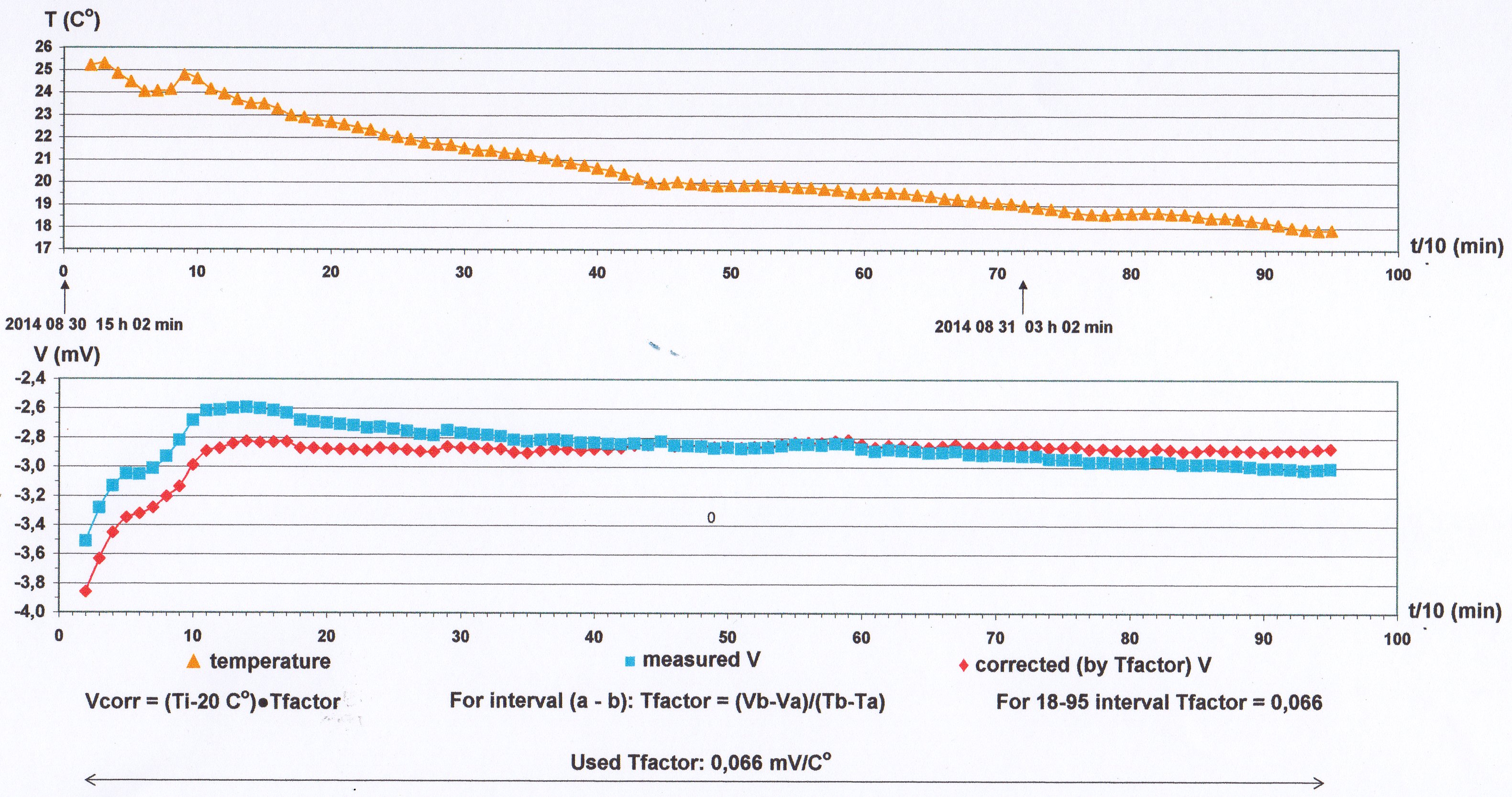
Please look at the larger version of the Figure by klicking the + in the lower right corner what will appear when you draw the cursor to the figure.
Figure 1: Temperature effect correction of potential time series (V) measured with long gypsum type electreode couple in ground pit (grassy garden)
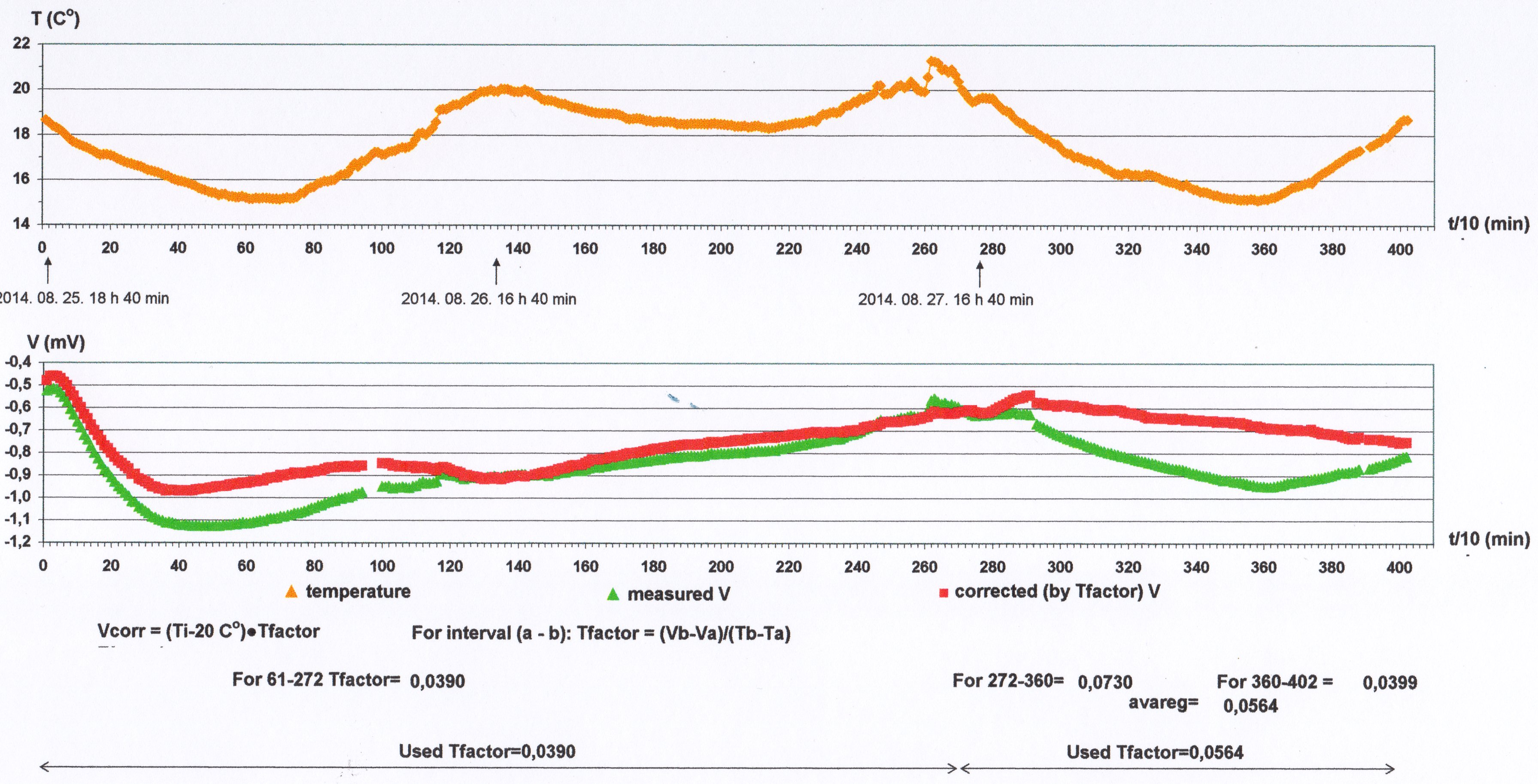
Please look at the larger version of the Figure by klicking the + in the lower right corner what will appear when you draw the cursor to the figure.
Figure 2: Temperature effect correction of potential time series (V) measured with long gypsum type electrode couple in ground pit.
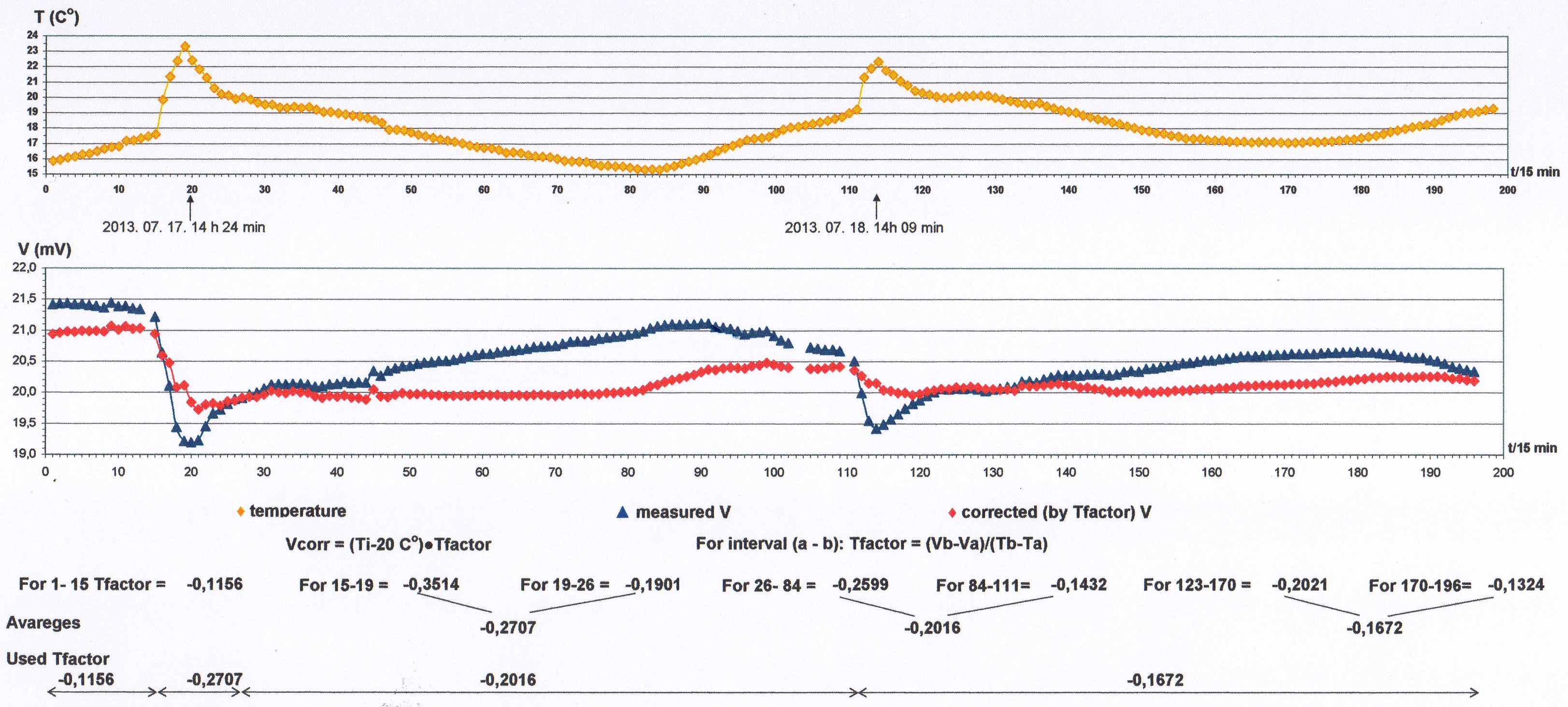
Please look at the larger version of the Figure by klicking the + in the loright corner whwill appear when you draw the cursor to the figure.
Figure 3: Temperature
effect correction of
potential time series (V) measured with long
ceramic slab gypsum
type electrode couple
in ground pit
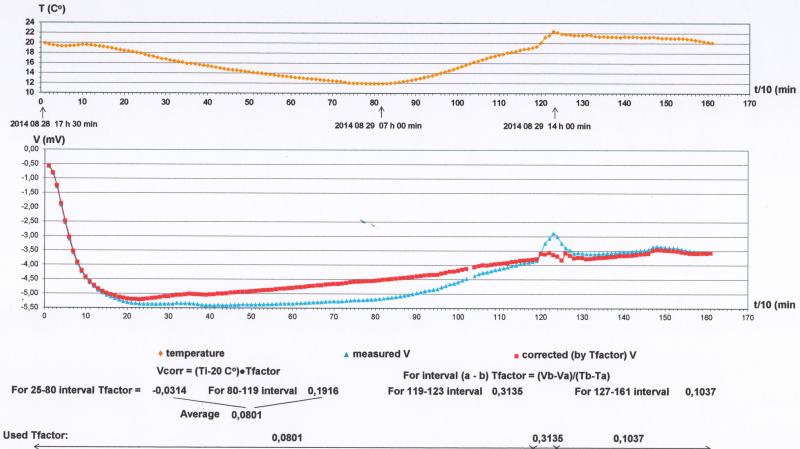
Please look at the larger version of the Figure by klicking the + in the lower right corner what will appear when you draw the cursor to the figure.
Figure 4: Temperature effect correction of potential time series (V) measured with long gypsum type electreode couple on bentonite.
Conclusion:
The Tfactor of long gypsum electrode couple (set on normal ground) was in the interval ±0,035 – 0, 075 mV/Co while the Tfactor of long ceramic slab gypsum electrode couple (set on normal ground) was in the interval ±0,11 – 0,21 mV/Co.
So in case of MT signal with period 24000 sec (6,67 h) and 5 Co temperature change, the temperature effect (appeared on long gypsum electrode couple) is ±(0,18-0,38) mV. In case of MT signal with period 36000 sec (10 h) and 10 Co temperature change, the temperature effect is ±(0,35-0,75) mV.
Note:
The above values of Tfactor can not be used for correction of field data measured with given electrode couple at given measuring station and ground. These values can only be used to raise awareness of operator and interpretator, so as:
Possible errors caused for MT data
For „smaller”-period signals (˂ 1000 sec) used in the research of raw materials, it is likely that the MT signal accuracy practically is not influenced by the temperature effect. However for „larger” (range of 104 sec) periods used in case of deep investigations, the DC drift arising as (Tfactor)x(change of temperature at duration of the period) can not be negligible compared to the amplitude of MT signal. One has to consider that this amplitude shall be about 10 time greater than the DC drift.
Possible errors caused for SP data
In case of PS measurements (especially monitoring) one has to consider the possible temperature effect, if the expectable PS values are ≤ (Tfactor)x(temperature change during the measurements). In this case, only the anomalies can be reliably real adopted which have at least 10 times greater than the possible temperature effects.
Is useful to measure the temperature of the electrodes during some monitoring to estimate the temperature effect and correc the data if necessary.
Nonpolarizing electrodes, sensors, non polarizable electrodes
Ringlo ut 39
Budapest 1221
ph: +36 1 2261870
alt: +36 30 2123517
simandra